
Why every zone matters (and why we don’t push max effort every day)
By Jennifer Hart
If you’ve ever left a Board30 class thinking “that felt easier than last time, is that bad?” — I want you to hear this: no. That’s not a bad sign. That might be exactly the point.
Did you know that elite endurance athletes spend most of their training time, somewhere around 70 to 80%, in what’s called an easy aerobic zone? Not sprinting. Not maxing out. The kind of effort where you could still hold a conversation. That’s where a huge amount of the real, lasting progress actually happens.
That idea changed how I think about programming classes, and I want to walk you through why.
Your heart rate tells a story, not a score
Your heart rate isn’t something to chase to the top. It’s more like a dial, and different positions on that dial do different jobs. Some days your body needs a hard push. Some days it needs quiet, steady work. Some days it just needs to recover. All of it counts. All of it builds something.
Here’s what each zone is actually doing for you.
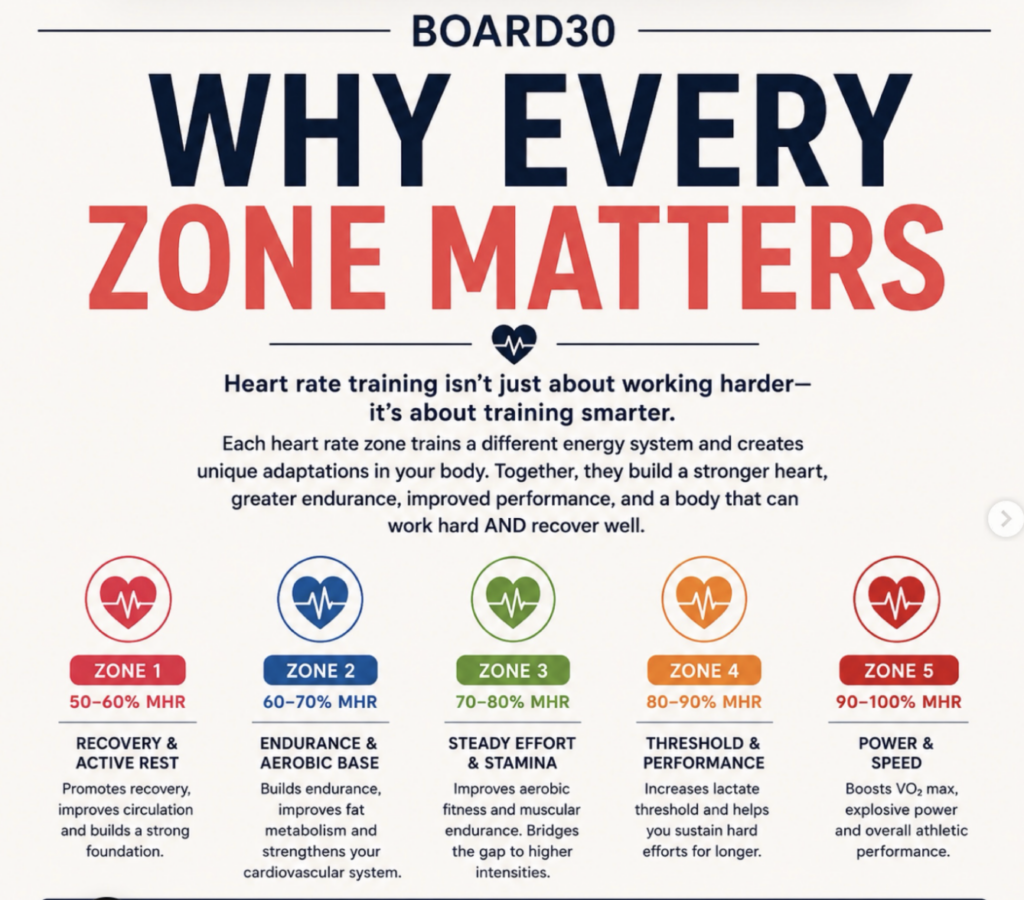
Zone 1, the recovery zone. This is the gentlest end of the dial. It gets blood moving, helps your muscles recover, and eases soreness after a tougher workout. If you’ve ever wondered whether a slow walk “counts,” this is your answer. It does. Recovery is where your body actually adapts and gets stronger. The hard workout doesn’t do that on its own. The rest around it does.
Zone 2, your foundation. It’s an easy, sustainable effort, one where you can still talk. And it’s doing more than it looks like it’s doing. It’s what improves your endurance so you’re not winded halfway up the stairs. It’s what helps your body use fat for fuel more efficiently. It’s what makes recovery from harder days faster. This is the zone that makes the rest of your life easier. Playing on the floor with a grandkid, keeping pace on a walk with a friend, getting through a long travel day. That’s Zone 2 doing its job in the background.
Zone 3, the in-between. Breathing picks up here, and conversation gets a little harder. It builds real aerobic fitness and muscular endurance. It’s also the zone that’s easiest to overdo. If every workout lives here and nowhere else, you can end up working hard without seeing the progress you’re after. Balance matters more than effort alone.
Zone 4, the harder push. Talking becomes difficult here. This is where your body learns to sustain a harder effort for longer, and where your cardiovascular capacity gets a real challenge. This is a “some days” zone, not an “every day” zone.
Zone 5, the peak. Short, near-maximal bursts. This one develops power and speed, and a little goes a long way. It’s meant to be a small piece of the picture, not the whole workout.
Why this matters for how we build your classes
None of these zones is the “good” one and none of them is the “bad” one. They each build something different, and they work together. A class that only ever maxes you out isn’t necessarily doing more for you. Sometimes it’s doing less, because your body never gets the steady, easy work that actually builds the foundation everything else stands on.
That’s why not every Board30 class is designed to leave you flattened. Some days you’ll push hard. Other days the focus is on movement quality, steady effort, or recovery. Both are working. Both are needed.
So if a class feels a little easier than you expected, trust that. It’s not a day off from progress. It’s part of how progress actually gets built, one zone at a time.